In the mining industry, efficiency and safety are paramount. One essential piece of equipment that significantly enhances operational productivity is the Mining Forklift. These specialized machines are designed to handle heavy loads in harsh environments. According to a report by the International Journal of Mining Engineering, the global mining forklift market is projected to grow by 5.2% annually over the next five years.
Industry expert Dr. Sarah Conners states, “Mining Forklifts are revolutionizing material handling, ensuring not just speed but also worker safety.” Her insights highlight the importance of modern machinery in addressing tough mining conditions. Mining Forklifts are uniquely equipped with features such as reinforced frames and advanced lifting capacities, making them indispensable in today’s mines.
However, challenges remain. Operators must receive proper training to navigate complex terrains effectively. The potential for human error exists, which can compromise safety measures. Therefore, ongoing education and equipment maintenance are crucial for maximizing the benefits of Mining Forklifts.
Definition of a Mining Forklift and Its Purpose
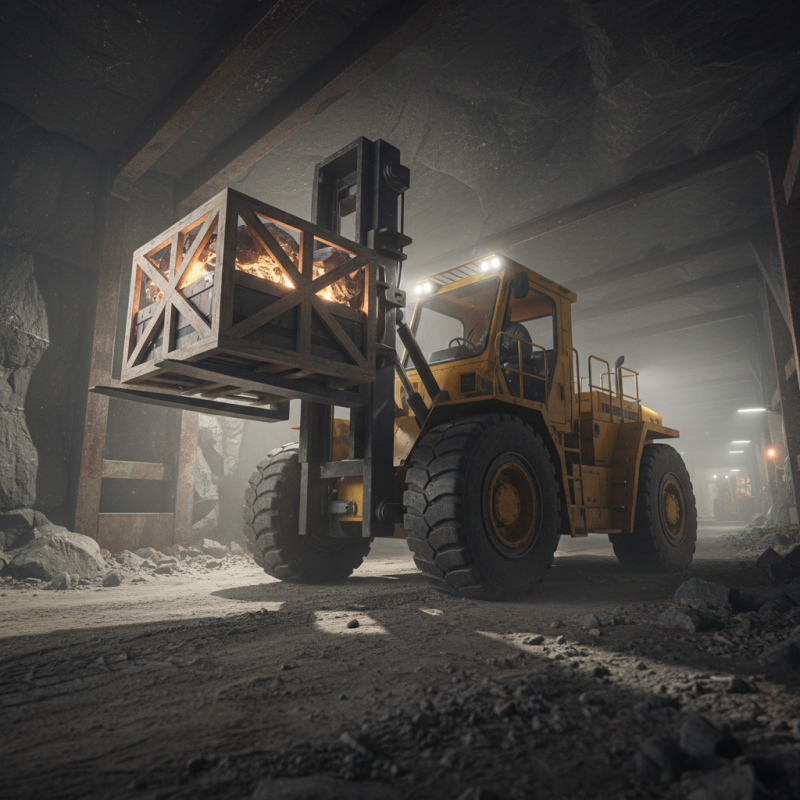
A mining forklift is a specialized piece of equipment designed to lift and transport heavy materials in mining operations. Its primary purpose is to handle bulk materials, tools, and equipment efficiently. Unlike standard forklifts, mining forklifts are built to withstand rugged environments. They often feature reinforced frames and powerful lift capabilities, allowing them to operate in harsh conditions.
The design of a mining forklift includes wide tires for stability on uneven terrain. Many models are equipped with enhanced safety features due to the high-risk nature of mining sites. Operators must be trained to navigate these machines under various conditions. This training ensures that they can solve unexpected issues, like shifting loads or equipment malfunctions.
While mining forklifts boost productivity, they also come with challenges. Operators often face limited visibility when maneuvering in tight spaces. Moreover, the weight of some materials can lead to overloading risks if not managed carefully. Regular maintenance is vital to ensure safety and reliability. Operators must remain vigilant and proactive, adapting their techniques as needed to prevent accidents.
Components of a Mining Forklift and Their Functions
Mining forklifts play a crucial role in the efficiency of mining operations. Understanding their components is vital for maximizing productivity. A mining forklift typically consists of an operator cabin, lifting forks, a power unit, and safety mechanisms. Each part serves a unique function that contributes to its overall performance.
The operator cabin is designed for visibility and comfort. It's often equipped with advanced monitoring systems. These systems provide real-time data on load weight and operational status. The lifting forks must endure heavy loads, sometimes exceeding several tons. Materials for the forks include high-grade steel to resist deformation.
The power unit is key to the forklift's functionality. Many are powered by diesel or electric motors. According to industry reports, electric mining forklifts are gaining popularity due to their lower emissions. Safety mechanisms, such as overload prevention systems, protect workers and equipment. Mines that prioritize these safety features report up to a 30% reduction in workplace accidents. Despite advances, regular maintenance is still a challenge. Up to 20% of equipment downtime in mining operations can be attributed to poorly maintained forklifts. Efficient management of these components can significantly impact a mine's overall productivity.
What is a Mining Forklift and How Does it Work? - Components of a Mining Forklift and Their Functions
| Component |
Function |
Specifications |
| Forklift Frame |
Supports all components and provides structural integrity. |
Steel construction, weight capacity of 15 tons. |
| Hydraulic System |
Drives lifting and lowering of forks. |
Hydraulic pump with 2000 PSI pressure. |
| Forks |
Used to lift and move heavy materials. |
Adjustable width, length: 1.5 meters. |
| Operator's Cabin |
Provides ergonomic control and safety for the operator. |
Enclosed design with air conditioning. |
| Wheels |
Provides mobility on different terrains. |
Heavy-duty rubber tires, suitable for rough surfaces. |
Operating Principles of a Mining Forklift
A mining forklift is a specialized piece of equipment designed for lifting and transporting heavy materials within a mining environment. Its operating principles hinge on its robust hydraulic system, which enables it to handle significant weight with ease. The hydraulic mechanism works by using pressurized fluid to power the lifting arms and fork, allowing operators to raise loads to considerable heights. This system also provides crucial stability, which is vital in uneven terrains typical of mining sites.
The design of a mining forklift incorporates heavy-duty tires to navigate rough surfaces. Operators rely on control buttons to maneuver the equipment accurately. Safety is crucial, yet challenges remain. Operators must be vigilant of their surroundings to avoid accidents. Poor visibility can lead to mistakes, highlighting the need for ongoing training. Regular maintenance is essential to ensure that hydraulic systems function optimally, as neglect can result in malfunctions.
Each operation offers learning opportunities. For instance, an operator may misjudge a load's weight, resulting in tipping. Such experiences inform best practices for future tasks. Ultimately, while mining forklifts enhance efficiency, their successful operation requires skilled personnel who prioritize safety and adaptability.
Safety Measures and Best Practices in Mining Forklift Operations
Mining forklifts play a crucial role in material handling within the mining industry. However, safety must be the top priority during their operations. According to the National Institute for Occupational Safety and Health (NIOSH), more than 90% of forklift-related accidents are preventable with proper training and awareness.
Introduction of proper safety measures is vital. Operators should always wear appropriate Personal Protective Equipment (PPE), such as helmets, gloves, and steel-toed boots. Regular maintenance of forklifts is also essential. A study from the Mine Safety and Health Administration (MSHA) indicates that maintenance defects account for approximately 15% of forklift accidents. A lack of inspections can lead to mechanical failures, putting workers at risk.
Training programs should emphasize lift capacity limits. Overloading can cause tipping and accidents. Furthermore, operators must be trained to engage in safe driving practices. One-third of forklift-related fatalities occur while the vehicle is in motion. Installing speed limits and enforcing pedestrian zones can prevent collisions.
Despite advancements in technology, many facilities still neglect comprehensive training and safety protocols. Addressing these gaps can lead to significant improvements in overall safety.
Applications of Mining Forklifts in the Mining Industry
Mining forklifts play a crucial role in the mining industry, facilitating the movement of heavy materials. These machines are designed to operate in challenging environments. They handle tasks that require lifting and transporting loads efficiently. In underground mining, forklifts help transfer equipment to hard-to-reach areas. This improves workflow and reduces downtime.
Forklifts are also used above ground to move mined resources. They load and unload trucks, ensuring timely distribution. Their versatility is essential for mining operations. Forklifts can navigate narrow pathways, making them invaluable on various job sites.
Tips for operators include regular maintenance checks to ensure reliability. Inspecting the lift and hydraulic systems is vital for safety. Additionally, provide proper training for all operators. This minimizes accidents and enhances productivity. Remember, operational efficiency can be improved by selecting the right forklift type for specific tasks. Understand the job requirements before deciding on your equipment.
Applications of Mining Forklifts in the Mining Industry
FAQS
: A mining forklift is designed to lift and transport heavy materials in mining operations.
It efficiently handles bulk materials, tools, and equipment.
Mining forklifts have reinforced frames and are built to withstand rugged environments.
Operators should wear appropriate Personal Protective Equipment like helmets and steel-toed boots.
Regular maintenance prevents mechanical failures that can put workers at risk.
Overloading can lead to tipping and serious accidents during operation.
Operators should be trained to navigate tight spaces and manage loads carefully.
Proper training decreases accident rates and increases operators' awareness of risks.
Speed limits help prevent collisions and enhance safety for all site personnel.
Many facilities neglect comprehensive training and safety protocols, which can be dangerous.
Conclusion
A Mining Forklift is a specialized piece of equipment designed to facilitate the transportation and handling of materials in the mining industry. Its primary purpose is to improve efficiency and safety when moving heavy loads, such as machinery parts or mined resources. The components of a Mining Forklift include the frame, lifting mechanism, controls, and safety features, each playing a crucial role in its operation.
Operating a Mining Forklift involves understanding its principles, including load capacity and stability management. Safety measures and best practices, such as regular maintenance and operator training, are essential for preventing accidents in the rugged mining environment. Mining Forklifts are vital for various applications within the mining sector, enhancing operational productivity and ensuring safer material handling processes.
 Wings Machinery
