Wings Machinery Wings Machinery

2026 Best Off Road Forklift Types for Global Buyers

Time:2026-09-17 Author:Isabella
0%

Choosing the right Off Road Forklift in 2026 requires more than comparing lifting capacity and price. Global buyers face steep construction sites, muddy farms, uneven warehouses, and remote industrial yards. Each environment demands a different combination of traction, ground clearance, stability, and operator visibility.

This guide examines the leading off-road forklift types for international applications. It considers rough-terrain forklifts, telescopic handlers, truck-mounted models, and compact all-terrain units. Practical details matter. A machine working on wet clay needs deep-tread tires and strong torque. A unit carrying stone pallets on a slope needs dependable brakes and a low center of gravity. Small differences can affect safety and productivity.

Real operating conditions decide the best choice.

Reliable selection also requires careful attention to engine emissions, noise limits, service access, spare parts, and regional certification requirements. Specifications may look impressive on paper, yet performance can change sharply with attachments, weather, and poor maintenance. Buyers should verify load charts under real working conditions, not rely only on brochure figures. Local dealer support is equally important, especially when a machine operates far from major cities.

Some recommendations will remain imperfect. No single forklift suits every climate, industry, or budget. Even experienced purchasing teams can overlook tire pressure, hydraulic response, or operator training. That is why field demonstrations, inspection records, and independent technical advice deserve serious consideration. The strongest decision balances capacity with reliability, total ownership cost, and long-term support.

2026 Best Off Road Forklift Types for Global Buyers

What Defines an Off-Road Forklift in 2026

What Defines an Off-Road Forklift in 2026

An off-road forklift is built for uneven ground, not just warehouse floors. It typically uses deep-tread tires, higher ground clearance, and a reinforced chassis. These features help it cross gravel, mud, compact soil, and broken concrete.

Capability depends on more than tire size. A practical machine needs balanced weight distribution, strong hydraulic control, and predictable braking on slopes. Four-wheel drive improves traction, but it does not remove rollover risks. Operators still need training, clear visibility, and correctly rated loads. That matters.

In 2026, buyers should also examine energy use and operating data. Electric models may suit quieter construction sites, while diesel or hybrid systems can support longer outdoor shifts. The right choice depends on charging access, weather, duty cycles, and local requirements. Telematics can record overload events, service intervals, and battery performance. Useful, but not perfect.

A forklift may be advertised as rough-terrain equipment, yet its attachments can change stability dramatically. A long fork, clamp, or bucket shifts the load center. Measure twice. Field checks should include tire condition, mast movement, steering response, and slope performance. Many purchasing errors happen when buyers compare lifting capacity alone. Ground conditions, operator habits, and maintenance quality often decide the real result. There is no universal off-road specification. Careful site assessment remains necessary.

Main Types of Off-Road Forklifts and Their Applications

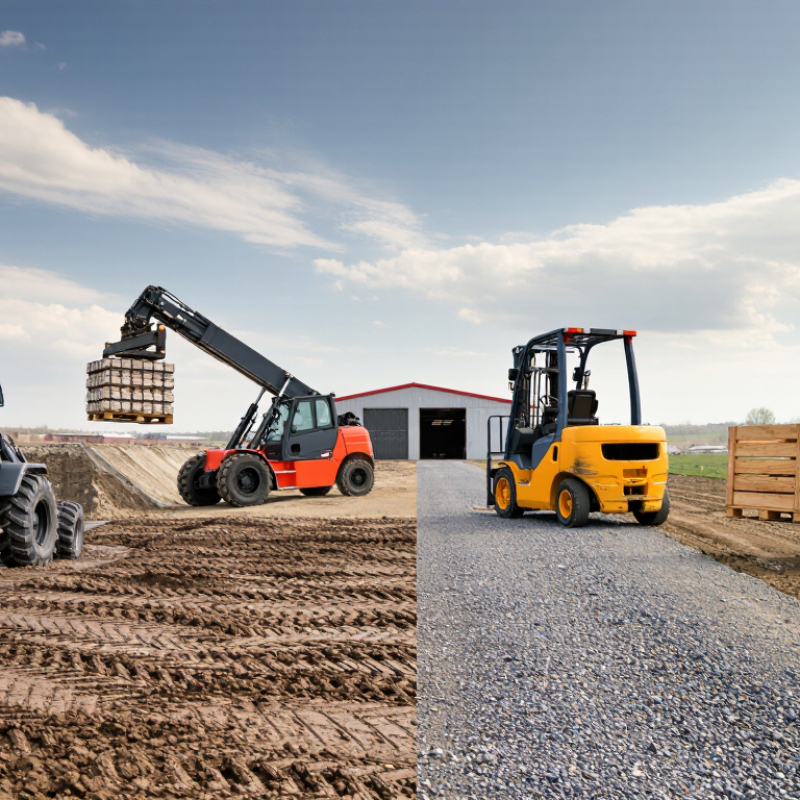
Off-road forklifts are built for uneven ground, loose soil, and outdoor loading points. The main type is the rough-terrain counterbalance forklift. Large pneumatic tires, high ground clearance, and a stable mast suit construction sites, farms, and timber yards. Typical capacities range from 2.5 to 10 tonnes, depending on configuration. A telehandler adds a telescopic boom, allowing operators to place pallets on upper floors or across obstacles. It is useful for roof work, agricultural storage, and infrastructure projects.

Truck-mounted forklifts offer another practical option. They travel with delivery vehicles and unload materials where fixed equipment cannot reach. Compact all-terrain forklifts work well in landscaping, small farms, and narrow rural sites. Industry selection should consider ground pressure, lift height, attachment weight, and transport width. The wrong tire choice can reduce stability quickly. It happens.

The U.S. Occupational Safety and Health Administration links powered industrial trucks with about 85 workplace fatalities and 34,900 serious injuries each year. That figure includes multiple forklift categories, but it shows why terrain assessment matters. Tips: Match the machine to the surface before comparing horsepower. Check rated capacity at the actual boom angle. Confirm visibility around the load. Review operator training and daily inspection records. Research from the Industrial Truck Association also stresses that rated capacity changes with attachments and load centers. Buyers should request test data, service intervals, and regional parts support. A cheaper machine may become expensive when downtime reaches a remote worksite. Even experienced operators can misjudge soft soil after rain.

Key Performance Features for Different Terrain Conditions

For 2026 global buyers, off-road forklift selection should start with terrain, not lifting capacity. A pneumatic-tire rough-terrain forklift suits gravel yards, mud, and broken concrete. High ground clearance, four-wheel drive, limited-slip traction, and sealed electrical connectors matter more than cosmetic power. Electric four-wheel-drive models can work indoors and outdoors when water protection is documented. On steep sites, compare rated capacity at the actual load center and slope. ISO 5053-1:2020 provides useful terminology, while local regulations still govern operation.

A telehandler fits farms and construction sites needing reach over obstacles. Its load chart changes with boom angle, extension, and stabilizer position. A compact articulated forklift turns more easily between trees or narrow work zones. It may sacrifice side-slope confidence. For sand, choose wide pneumatic tires and a protected air intake. For wet clay, prioritize self-cleaning tread, axle protection, and service access. OSHA estimates about 85 forklift-related deaths and 34,900 serious injuries annually in the United States. That figure is not terrain-specific, but it exposes a common buying mistake: treating stability as a brochure number. I would not trust one gradeability figure.

Tips: Ask suppliers for a field demonstration with your heaviest pallet. Measure stopping distance, tire sinkage, turning clearance, and cold-start behavior. Request test data, not verbal claims. Research and Markets’ 2024 rough-terrain forklift outlook reports continued global growth through 2029. Regional fuel, emissions, and service requirements can still change the best choice. Keep a written load chart in the cab. Recheck it after attachments change.

2026 Best Off Road Forklift Types for Global Buyers - Key Performance Features for Different Terrain Conditions

Forklift Type Typical Rated Capacity Typical Lift Height Ground Clearance Drive and Tyre Configuration Typical Gradeability Best Terrain Conditions Key Performance Features Important Buying Considerations
Compact Rough-Terrain Forklift 2.0–3.5 tonnes 3.0–6.0 m 230–320 mm Four-wheel drive
Pneumatic or flotation tyres
25–35% on firm ground Construction sites Landscaping Uneven yards Compact turning radius, good visibility, articulated or oscillating axle options, and sufficient clearance for shallow ruts and loose surfaces. Confirm machine width, turning radius, tyre flotation, and attachment compatibility when access routes are narrow.
Heavy-Duty Rough-Terrain Forklift 4.0–7.0 tonnes 3.0–7.0 m 280–400 mm Four-wheel drive
Large pneumatic tyres
30–40% on firm ground Infrastructure projects Quarries Timber yards High torque, reinforced chassis, strong axle load capacity, robust mast construction, and improved traction on gravel, mud, and compacted soil. Check axle ratings, hydraulic cooling, braking performance, and the residual capacity at maximum reach.
Telehandler with Fork Carriage 2.5–5.0 tonnes 6.0–18.0 m 300–450 mm Four-wheel drive
Pneumatic agricultural or industrial tyres
25–40% on firm ground Building construction Agriculture Roof-level handling Telescopic reach, hydraulic attachment changes, stabiliser options, load moment control, and the ability to place loads at height or over obstacles. Rated capacity decreases as boom reach increases; review the complete load chart rather than only the maximum capacity.
All-Terrain Telescopic Forklift 3.0–6.0 tonnes 7.0–20.0 m 350–500 mm Four-wheel drive
Wide flotation tyres
30–45% on firm ground Soft soil Agricultural fields Rough construction sites High ground clearance, four-wheel steering modes, self-levelling chassis options, long reach, and improved stability on changing terrain. Evaluate ground pressure, boom deflection, stabiliser deployment space, and performance on wet or sloping ground.
Truck-Mounted Rough-Terrain Forklift 2.0–3.5 tonnes 2.5–4.5 m 220–300 mm Pneumatic tyres
Detachable or integrated mounting system
20–30% on firm ground Remote deliveries Utility work Distributed job sites Transportable with the delivery vehicle, rapid deployment, low site logistics requirements, and useful reach for unloading materials away from access roads. Verify mounting strength, vehicle payload, road regulations, stabilisation requirements, and transport clearance.
Container and Port Rough-Terrain Forklift 8.0–16.0 tonnes 3.0–6.0 m 300–450 mm Heavy-duty pneumatic tyres
Four-wheel drive or high-capacity drive axle
15–25% on firm ground Ports Freight terminals Heavy logistics yards High residual capacity, reinforced mast, powerful hydraulics, heavy counterweight, and durable cooling and braking systems. Match the forklift to container weight, load centre, surface bearing capacity, operating cycle, and yard traffic controls.
Sand and Desert-Spec Rough-Terrain Forklift 2.5–5.0 tonnes 3.0–6.0 m 300–450 mm Four-wheel drive
Wide low-pressure flotation tyres
15–30% on compacted sand Desert sites Dune edges Arid regions Reduced ground pressure, sealed electrical components, high-capacity air filtration, dust-resistant cooling, and traction-focused drive control. Specify suitable filtration, cooling protection, tyre sidewall strength, sand traction, and maintenance intervals for abrasive dust.
Wetland and Mud-Optimised Forklift 2.5–5.0 tonnes 3.0–6.0 m 300–450 mm Four-wheel drive
Deep-lug or flotation pneumatic tyres
15–30% depending on soil moisture Rainy climates Plantation work Unpaved yards High traction, differential-lock options, sealed driveline components, corrosion protection, and improved mud clearance around axles and chassis. Request actual traction data for the intended soil; no forklift should be operated on unstable ground without a site risk assessment.
Snow and Cold-Climate Rough-Terrain Forklift 2.5–5.0 tonnes 3.0–6.0 m 250–400 mm Four-wheel drive
Cold-weather pneumatic or stud-compatible tyres
15–30% on cleared, compacted snow Cold regions Snow-covered yards Winter construction Cold-start systems, hydraulic fluids rated for low temperatures, enclosed operator protection, battery heating options, and traction control. Confirm starting performance, hydraulic viscosity range, battery capacity, visibility in snowfall, and braking on ice.
Electric Rough-Terrain Forklift 2.0–4.0 tonnes 3.0–6.0 m 220–350 mm Electric drive
Pneumatic or non-marking terrain tyres
15–25% on firm ground Indoor-outdoor sites Low-emission zones Noise-sensitive areas Low operating noise, zero tailpipe emissions, precise torque control, regenerative braking options, and reduced routine engine maintenance. Assess battery capacity, charging infrastructure, ambient temperature, duty cycle, water protection, and performance on ramps.

Note: The specifications shown are representative market ranges for comparison. Actual capacity, gradeability, lift height, ground clearance, tyre performance, and stability depend on the specific configuration, load centre, attachment, surface condition, weather, and applicable safety standards. Gradeability figures are not a substitute for a site-specific risk assessment or the manufacturer’s load chart.

How to Choose the Right Forklift for Global Operations

2026 Best Off Road Forklift Types for Global Buyers

How to Choose the Right Forklift for Global Operations

Choosing an off road forklift starts with the worksite, not the brochure. Measure ground conditions, travel distances, load weights, and working heights. A rough-terrain forklift suits uneven yards, construction zones, and unpaved storage areas. A telehandler adds reach for elevated pallets and materials. Compact models help where access is narrow. It depends.

Check the load chart carefully. A machine lifting 3,000 kilograms near the ground may handle far less at full reach. Record the heaviest load, its center of gravity, and the attachment used. Fork extensions, buckets, and clamps can change stability. Small details matter.

Global operations require more than lifting power. Compare diesel, electric, or hybrid options against fuel access, charging reliability, climate, and service skills. Dust, heat, humidity, and steep gradients can shorten component life. Ask for corrosion protection and cold-start performance when needed. Confirm spare-part availability before shipment. A low purchase price can become expensive downtime. I have seen specifications look excellent until local technicians faced unfamiliar systems. That risk deserves an honest review. Operator visibility, braking response, tire design, and cabin protection should be tested in realistic conditions. Request practical demonstrations with your own pallet sizes and surfaces. Choose capacity with a safety margin, but avoid buying a machine that spends most of its life oversized and underused.

Safety, Maintenance, and Compliance Considerations for Buyers

For global buyers, off-road forklift selection begins with the worksite, not the brochure. Four-wheel-drive forklifts suit muddy construction yards and uneven farms. Telescopic handlers provide reach for elevated loads. Articulated models improve maneuverability in narrow, irregular spaces. Load charts must match attachments, slope angles, and ground conditions. Never judge capacity from lifting height alone.

Safety remains measurable. The U.S. Occupational Safety and Health Administration estimates that forklifts cause about 85 fatalities and 34,900 serious injuries annually. That figure should influence purchasing decisions. Buyers should request operator-training records, stability testing, and documented pre-use inspection procedures. OSHA rules apply in the United States, while other markets may follow ISO or national requirements. ANSI/ITSDF B56.6 is a key reference for rough-terrain forklift design and operation.

Maintenance details are practical. Inspect tire cuts, loose wheel nuts, fork cracks, hydraulic leaks, and damaged seat belts before each shift. Keep cooling screens clean when dust covers the radiator. Mud hides defects. It also accelerates corrosion. Maintenance intervals should follow engine hours and working severity, not calendar dates alone. A machine used near saltwater needs closer inspection. A checklist helps, but it can still miss gradual mast wear. Buyers should plan independent inspections and retain service records for audits. Compliance is not a label; it is daily evidence.

2026 Best Off-Road Forklift Types for Global Buyers

Typical rated-capacity ranges, with key safety, maintenance, and compliance considerations.

Safety Verify load charts at the actual load center, lift height, attachment, and terrain conditions. Seat belts, visibility controls, and rollover protection are essential.
Maintenance Prioritize daily pre-use inspections, tire and steering checks, hydraulic leak detection, brake testing, and service records matched to operating hours.
Compliance Confirm local requirements for operator training, machine marking, periodic inspection, emissions, lighting, and attachment compatibility before purchase.

Capacity ranges are typical market bands in metric tonnes, not guaranteed working capacities. Actual capacity must be confirmed from the manufacturer’s load chart for the selected configuration. Reference frameworks include ISO 5053-1, ISO 3691-1, and applicable national workplace-safety regulations.

FAQS

What defines an off-road forklift in 2026?

It is designed for gravel, mud, compact soil, and broken concrete. Deep-tread tires, high clearance, and a reinforced chassis are typical features.

Which off-road forklift types suit different work sites?

Rough-terrain counterbalance forklifts suit construction sites, farms, and timber yards. Telehandlers reach over obstacles, while truck-mounted models support roadside unloading.

How should buyers match a forklift to ground conditions?

Check soil firmness, slopes, mud, gravel, and ground pressure. Rain can soften soil quickly. Surface conditions matter more than horsepower alone.

Does four-wheel drive eliminate rollover risks?

No. Four-wheel drive improves traction but cannot prevent rollovers. Operators still need training, clear visibility, stable loads, and careful slope control.

How do attachments affect forklift stability?

Long forks, clamps, and buckets move the load center forward. This can reduce rated capacity and stability. Measure twice.

Should capacity be the main purchasing factor?

No. Compare lift height, boom angle, attachment weight, tire choice, transport width, and terrain performance. Capacity alone can mislead.

Which power system is suitable for outdoor operation?

Electric models may suit quieter sites with reliable charging. Diesel or hybrid systems may support longer shifts and difficult outdoor conditions.

What should operators inspect before using an off-road forklift?

Check tire condition, mast movement, steering response, brakes, visibility, and slope behavior. Review the load rating and daily inspection records.

How can operating data improve forklift management?

Telematics can record overload events, service intervals, and battery performance. Useful, but not perfect. Physical inspections still matter.

What mistakes should buyers avoid in 2026?

Do not compare machines by lifting capacity alone. Confirm local support, spare parts, service timing, and attachment ratings. A cheaper machine may create costly downtime.

Conclusion

An Off Road Forklift is designed to handle uneven ground, loose surfaces, slopes, and demanding outdoor work areas that standard warehouse forklifts cannot manage efficiently. In 2026, global buyers can choose from rough-terrain forklifts, compact all-terrain models, telehandler-style machines, and heavy-duty units for construction, agriculture, forestry, ports, and infrastructure projects. Each type offers different advantages in lifting capacity, ground clearance, maneuverability, reach, traction, and stability, making application and terrain assessment essential before purchase.

The right forklift should match the required load, lift height, operating environment, fuel or power preference, and transportation conditions. Buyers should also evaluate tire design, four-wheel drive, steering systems, operator visibility, weather protection, and attachment compatibility. Safety features, routine maintenance access, operator training, spare-parts availability, emissions requirements, and regional compliance standards are equally important for reliable global operations. A careful comparison of performance, total ownership cost, service support, and workplace conditions helps buyers select a durable, safe, and productive solution.

Isabella

Isabella

Isabella is a dedicated marketing professional with a sharp focus on driving brand growth and engagement through strategic content creation. With an extensive background in digital marketing, she combines her passion for storytelling with her keen understanding of industry trends to deliver......